What is an electrical network fault?
An electrical network fault is an abnormal condition that affects the normal operation of a power distribution network. It may include a short circuit, an earth fault or a broken conductor.
These incidents can result in:
- power outages;
- equipment damage;
- disruptions to the electricity supply;
- safety risks for people and electrical installations.
The challenge is therefore not only to detect the presence of a fault, but also to identify the affected area quickly so that field teams can take appropriate action.
On medium-voltage networks, however, locating the exact fault location can be challenging.

Why are electrical faults difficult to locate?
Faults are often invisible
On an underground network, cables are buried, making it impossible to visually identify the source of a fault in most cases.
Faults on overhead networks can also be difficult to detect. Insulation faults, electrical arcing or problems affecting an insulator may not leave any obvious visual indication during a field inspection.
As a result, fault-finding operations may have to cover a significant section of the network.
Intermittent faults
Some electrical faults are intermittent: they occur under certain conditions and then disappear before maintenance teams reach the site.
The phenomenon may be influenced by environmental conditions such as:
- humidity;
- wind;
- vegetation;
- insulation conditions.
Intermittent faults are particularly difficult to locate because the fault may no longer be present when the network is inspected.
Detection does not necessarily provide an exact location
Network protection systems can detect abnormal conditions and trigger the necessary protection functions.
However, detecting a fault does not necessarily mean that its exact location is immediately known.
Field teams may therefore need to:
- isolate different sections of the network;
- operate switching devices;
- carry out electrical measurements and tests;
- inspect network equipment on site.
These operations can increase the time required to identify the affected area and restore the power supply.
How can a fault be located on a medium-voltage network?
Several methods can be used to investigate and locate an electrical fault on a medium-voltage network.
Depending on the network configuration and the type of fault, these operations may include:
- visual inspection, particularly on overhead networks;
- sectionalising different parts of the network;
- electrical measurements;
- the use of dedicated fault detection and location equipment.
However, these methods may require several operations and can depend on the network configuration and site accessibility.
This is where medium-voltage fault indicators can provide valuable support to network operators.
Medium-voltage fault indicator: a solution for faster fault location
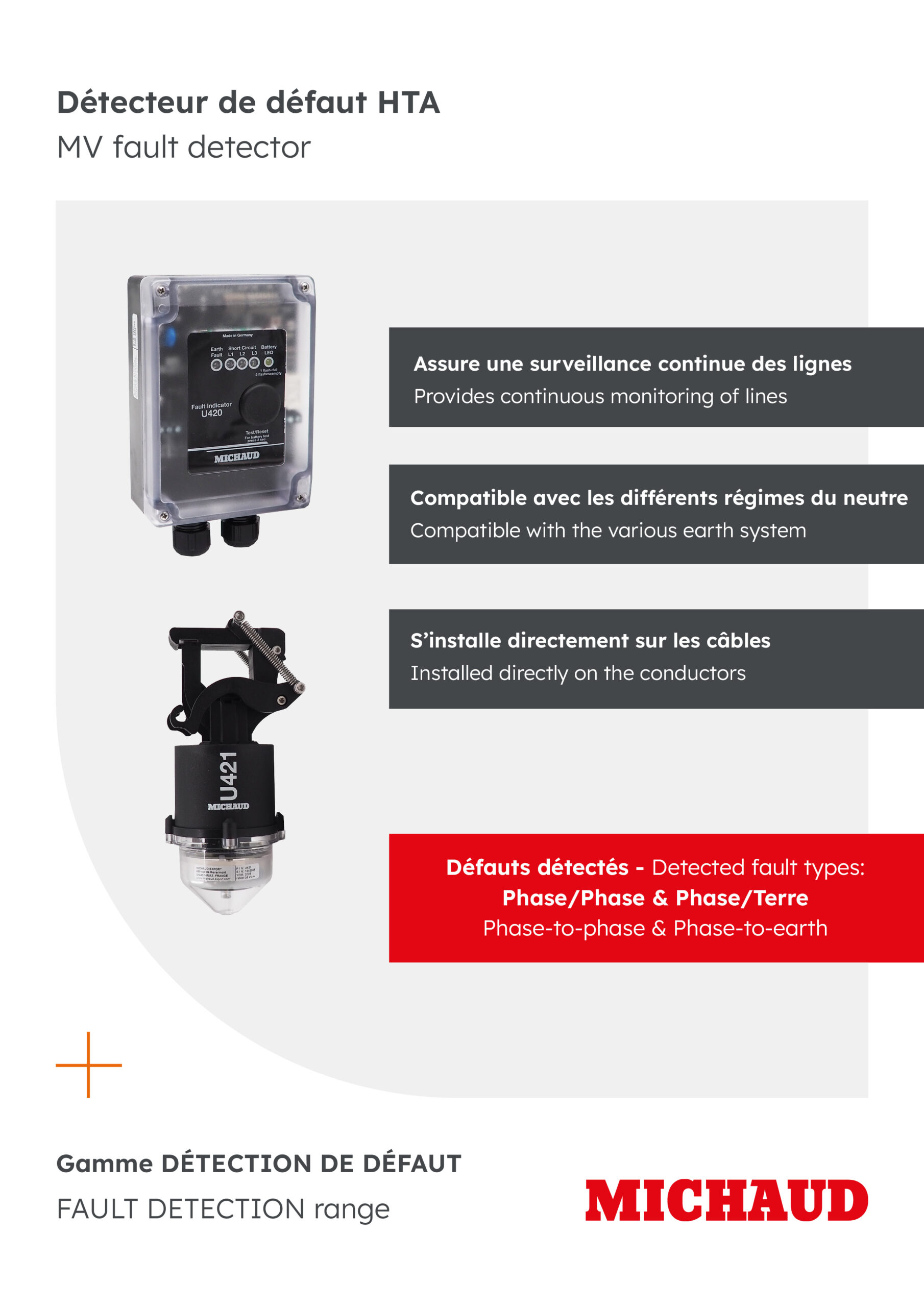
A medium-voltage fault indicator, also referred to as a fault passage indicator (FPI) depending on the technology, is designed to detect the passage of fault current on a section of the network.
It provides network operators with additional information to help determine the area in which the fault should be investigated.
Continuous monitoring of the electrical network
Depending on the technology, a fault indicator can monitor different electrical parameters, particularly current and, for some devices, voltage.
When a condition corresponding to a fault is detected, the device provides an indication.
The detection criteria depend on the technology and model. Some devices may use current thresholds, directional criteria or time delays to identify fault conditions.
Detecting different types of electrical faults
Medium-voltage fault indicators can be designed to detect different electrical phenomena, including:
- phase-to-earth faults;
- phase-to-phase faults;
- overcurrents associated with certain fault conditions.
The detection principle depends on the equipment and network configuration. Current thresholds, time delays and other available parameters may be configurable depending on the device.
The objective is to provide a reliable indication that helps operators identify the affected section of the network.
Supporting fault location and decision-making
A fault indicator acts as a fault passage indicator.
When several devices are installed along a network, their indications can be compared to help field teams identify the section in which the fault occurred and narrow down the search area.
This can help to:
- identify the affected area more quickly;
- reduce field troubleshooting operations;
- facilitate maintenance team interventions;
- reduce the time required for fault diagnosis.
A fault indicator does not necessarily replace detailed fault-location and diagnostic procedures. Rather, it provides an additional operational tool for network operators.
Connected solutions for smart grids
Some medium-voltage fault indicators feature communication capabilities that allow fault information to be transmitted remotely.
Depending on the equipment and network architecture, these devices can be integrated into SCADA supervision systems.
Remote transmission allows network operators to access information about network conditions more quickly, without necessarily waiting for an on-site inspection.
These capabilities support the development of increasingly monitored, automated and connected electrical networks, particularly as smart-grid technologies continue to develop.
Installation on overhead and underground networks
-
ault detection solutions can be adapted to different medium-voltage network configurations.
Underground networks
On underground networks, devices may be installed at substations or on equipment associated with medium-voltage cables, depending on the technology used.
They can indicate the network section in which a fault has been detected, helping field teams focus their investigation.
Overhead networks
On overhead networks, some fault indicators are designed to be installed directly on conductors.
Depending on their design, installation may be carried out using an insulated hot stick, allowing the device to be installed in accordance with the operating conditions of the network.
Installation characteristics and procedures must always comply with the manufacturer’s instructions and applicable safety requirements.
Conclusion: towards faster and more reliable fault location
Locating faults on medium-voltage networks can be challenging, particularly when the fault is invisible, intermittent or located on an extensive network infrastructure.
Medium-voltage fault indicators provide valuable additional information by indicating the passage of a fault on a specific section of the network.
Combined with protection systems, measurement equipment and remote supervision solutions, they can help to:
- speed up fault investigation;
- reduce intervention times;
- facilitate network diagnosis;
- improve continuity of supply.
As distribution networks become increasingly monitored and connected, fault indicators are therefore an important tool for improving the operation and maintenance of medium-voltage networks.