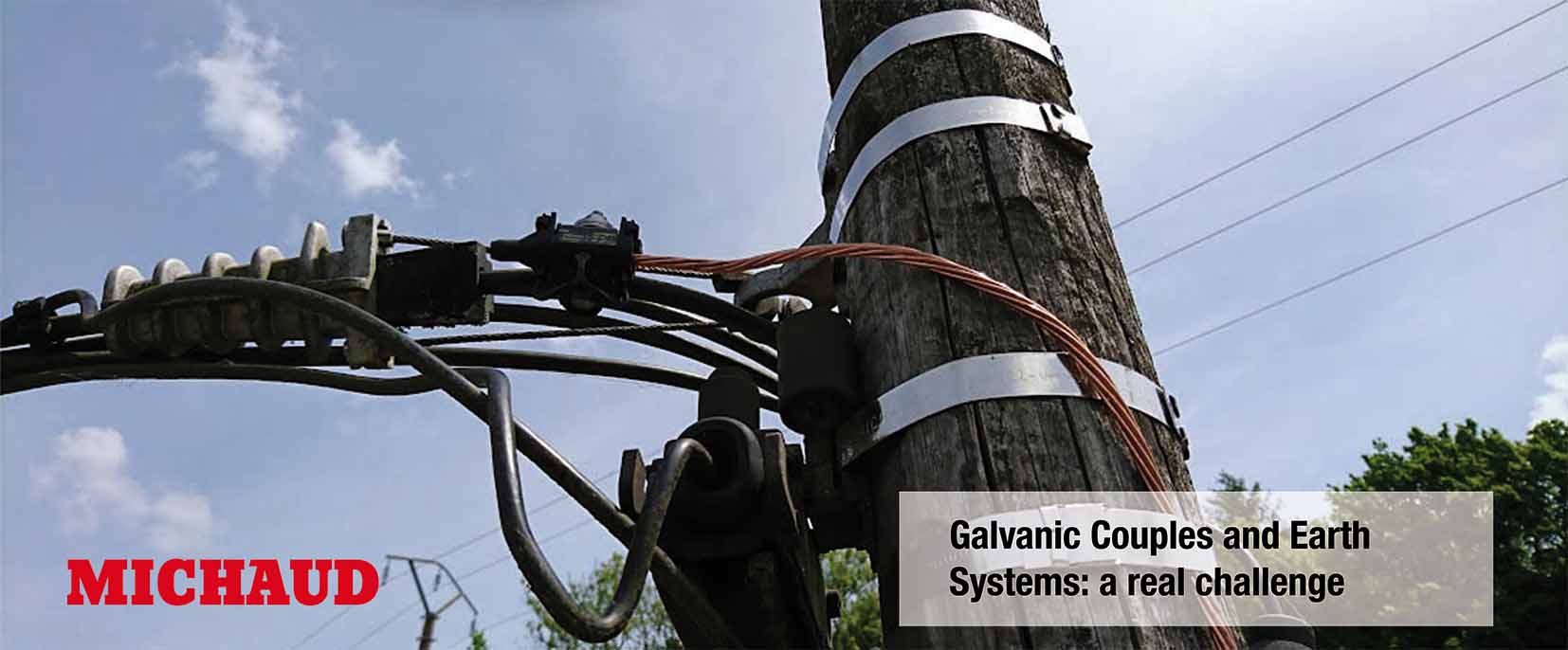
In electrical installations, earthing systems play a fundamental role in ensuring personal safety and equipment protection. However, a discreet phenomenon can significantly compromise their long-term reliability: the formation of galvanic couples. This electrochemical reaction, still insufficiently considered during design, can lead to accelerated corrosion of buried conductors and earth electrodes. Understanding this risk is essential to ensure durable and compliant earthing systems.
What Is a Galvanic Couple?
A galvanic couple occurs when two dissimilar metals are in electrical contact within a conductive environment, such as moist soil, concrete, or water.
Due to their different electrochemical potentials, one metal becomes the anode and corrodes preferentially, while the other becomes the cathode and is protected.
The greater the potential difference between the two metals, the faster and more severe the galvanic corrosion.
Common problematic combinations include:
- Copper / galvanized steel
- Copper / aluminium
- Copper / zinc
- Zinc / stainless steel
Why Are Galvanic Couples a Problem in Earthing Systems?
Earthing networks are particularly exposed because they often combine different materials while being permanently in contact with soil, which acts as an electrolyte.
Main consequences include:
1. Degradation of electrodes and conductors
Galvanic corrosion progressively reduces the effective cross-section of buried conductors and weakens earth rods.
2. Increase in earth resistance
A corroded electrode loses its ability to dissipate fault currents or lightning currents efficiently, potentially leading to non-compliance with standards.
3. Loss of electrical continuity
Localized corrosion can cause mechanical failure or disconnection, compromising the safety function of the earthing system.
Where Do Galvanic Couples Occur in Practice?
- Copper conductors connected to galvanized steel earth rods
- Equipotential bonding between steel reinforcement and copper earth strips
- Aluminium components installed in buried or damp environments
- Transitions between different metallic materials within the earthing network
In short, any interface between dissimilar metals represents a potential galvanic risk.
How to Prevent Galvanic Corrosion in Earthing Systems?
The following engineering best practices significantly reduce the risk of galvanic corrosion:
1. Use homogeneous materials whenever possible
Copper is widely preferred due to its excellent electrical conductivity and chemical stability.
2. Use bimetallic or insulating connectors
These solutions limit direct metal-to-metal contact between incompatible materials.
3. Protect all junctions
- conductive greases
- heat-shrink sleeves
- insulating resins
- bituminous tapes or coatings
4. Select earth electrodes according to soil conditions
Depending on soil resistivity, pH, moisture, and chemical composition, suitable options include:
- solid copper or copper-bonded rods
- stainless steel electrodes
- composite or corrosion-resistant solutions
5. Use sacrificial anodes in aggressive environments
In industrial or coastal areas, sacrificial anodes (zinc or magnesium) can be used to protect the primary earthing system.
Designing for Durability
Galvanic corrosion is a natural electrochemical phenomenon, but its impact on earthing systems can be severe if ignored. By selecting compatible materials, protecting metal interfaces, and accounting for environmental conditions from the design stage, engineers can ensure long-lasting, reliable, and safe earthing installations.
We recommend the use of the following galvanic couples:
• Copper / Copper
• Copper / Tinned Copper
• Galvanized Steel / Galvanized Steel
• Stainless Steel / Stainless Steel